Inflatable Canoeing Adventures - Buy this eBook!

Most of us can relate to the fun we had canoeing at summer camp when we were young. But that was nothing compared to the experience of whitewater kayaking that came next for me. I have always loved canoeing, though it always seemed difficult to participate. It has only been in the last decade that the development of inflatable canoes has made a big difference. You can more easily access rivers, you can store a canoe in your car, you can even take them on a plane. They are very light, very cheap, with little loss of functionality. Perfect for weekends away or campervan holidays. Social networking was the other big change. You can now use Facebook, etc to join canoeing adventures in your local region or abroad.

Inflatable Canoeing Adventures - view the table of contents! Click here to download the table of contents for this eBook, available for just $US7.95.

Sunday, February 14, 2010

Inflatable canoeing on the Manuwatu River, NZ

The Manuwatu River cuts its way through the Manuwatu Ranges, immediately NE of Palmerston North, 1 hour from Wanganui. The lower section described provides a suitable place to learn canoeing with instruction. The best support comes from one of the local clubs, or even scout groups for kids.
Entry point: There are two possible entry points.
The 1st entry is along the Masterton-Napier road crosses the river at Ngawarupoa(?). This upper section is grade 1-2, though it hosts a lot of willows, and for that reason good techical skills will be required to canoe this section. Entry to the river is easy because the river is crossed by the public road.
The 2nd entry for the second section starts just above the gorge. Coming from Palmerston North, there is a bridge as you emerge from the gorge, take a track off to the south. This track is through public common area. Drive along the track until you reach the river.

Our group mostly used fixed hull canoes and kayaks, however I was using my inflatable Sevlor Tahiti canoe. This river is not really suitable for inflatables in one respect - it is very windy under most conditions. The Manuwatu Ranges is home to many of NZ's wind farms. For this reason, it is not suitable. Contrary to expectation, the gorge area is not always sheltered from these winds, but can actually act as a conduit for them. If you are using an inflatable I suggest judging whether its better to follow the edge of the river (for shelter) or stay mid-stream to utilise the speed of the current. It is also advisable to use both seats, so your canoe sits lower, or to place a heavy carry bag in the front. Otherwise try to position yourself in the middle. If you sit at the back the front tends to catch in the wind. The more you can distribute your weight along the canoe the better. The less water in your canoe the better, so tip out any water if you stop. There were a few areas where we were fighting winds.

This gorge is not particularly scenic, though it was a good river to introduce my partner to canoeing. It was also a good opportunity to test two canoes that we had bought 2nd hand. Fortunately both worked, except for a slow leak in one compartment. Clearly the previous owner was too lazy to fit it. I have found you get a leak about one-in-ten times I go canoeing, and its easier to fix a leak than portage a fixed hull canoe around a rapid. Try slipping on some rock with a heavy canoe compared to a light air mattress.

If you are interested in learning more about how to canoe with inflatables - we have written an eBook on the topic - Inflatable Canoeing Adventures. We have used these Sevylor inflatables in Japan, NZ and Australia so far. The attraction is the functionality of the canoes, their lightness and compactibility, so you can pack them in the back of a car or even take them on a train, as I did in Japan. I think activity like canoeing adds an extra dimension to a holiday experience. i.e. Like mountain biking across the Himalayas. I'm not writing a book about that though...pity the sucker who does.

The following map provides location guidance.

View Canoeing trips in a larger map
------------------------------------
Andrew Sheldon www.sheldonthinks.com
Wanganui, New Zealand

Tuesday, July 21, 2009

Kayaking the Chico River

Last week we visited the area of Sagada, which hosts some of the Philippines best limestone caves. Actually I did not visit the caves, as I was quite sure they would not be as spectacular as Jenolan Caves, west of Sydney. Anyway, 10km south of Sagada is the town of Sabangan, which lies on the Chico River. The Chico River would have to be one of the better rivers in the Philippines for kayaking. The river has a continuous series of rapidsore interested in the canoeing, so for those who are similarly interested, I am planning a return to the area in May 2010 to kayak this river. The rapids are mostly grade 2-3. I hear there are grade 4-5 rapids, though based on my river observation from the main road, this is more likely the lower section. I only saw the river as far as east as the Sagada turn-off, and it was not suited to rafting (i.e. too narrow, too shallow). The Chico River flows from Mountain Province, a few hundred kilometres north of Manila, but it takes 6 hours alone to drive the 80km section from Baguio-Sagada because although the road is mostly sealed, its VERY windy. Fortunately there were no tricycles in this section.

I would also be worthwhile to take some time to walk along the river from Panorama ParkView to the town of Sabangan. I have no doubt that you should be able to get a tricycle back to your car if you leave your car there, otherwise its a steep walk back to the car. There appears to be a steep alternative exit further back (round trip). I did not do it on this walk, but I would like to return to the area to kayak the river and to walk along the Chico River. The pathway passes along the river through rice terraces.
Increasingly I see that the Dept of Tourism in the Philippines is starting to spend money on worthwhile project as these to boost tourism, and to give visitors something to do. If you are more interested in rafting, there are groups that run rafting trips on the river. I have information on this, or you can inquire at the Rock Inn, in Sagada. This is a fairly nice place to stay. Nice accommodation, though off-season you will have to wait a few hours for a meal as they do down to the markets to buy the food.
If you want to get to this area, I would advice coming in from the Nueva Viscaya province (east side). The road is not as good, but it will be faster, particularly as they are currently upgrading the road - sealing it with concrete. Baguio is a great market to buy food, and there are some good entertainment places there. Many foreigners like living there because its cheaper, cooler, though it is congested because of the mountain topography.
----------------------------------------------
Andrew Sheldon www.sheldonthinks.com

Friday, January 02, 2009

Indonesia - Rafting Adventures

Indonesia would have to be one of the most appealing rafting/canoeing playgrounds in the world if you are looking for exotic holiday adventures. There are a multitude of rivers to choose from. Some are within a few hours drive from Jakarta, though others in the back-blocks of West Kalimantan might take you 3 days to get to. That might sound like a great adventure, but consider the risk if you get injured.
One of the benefits of rafting in Indonesia is that you can run the rivers at any time of year since some rivers are feed by Springs. There are a range of rafting rivers in Indonesia providing trips from an enjoyable few hours in the jungle or rice padies (Bali or Java) to multi-day excursions through pristine jungle (Sulawesi and Sumatra).

1.Bali: This popular tourist island has a number of rivers that can be rafted.
i. Ayung River – grade 2 to 3 all year round
ii. Balian River – grade 2 to 3 in dry season, 4-5 after rain
iii. Unda River - The 12km long section of the Unda River is the most spectacular and challenging river in Bali with rapids ranging from grade 2 to 4.
iv. Ubaya River – No further info.
v. Telaga Waja River – this is a 2.5hr trip

2. Sulawesi: This island is occupied by a mix of Protestant, Christian, and Muslim people.
i. Sadan River – grade 3-4, it offers overnight trips, navigable most of the year, the best period is Nov-Mar. See www.sulawesi-adventure.com/itinerary/iga-109.html
.
ii. Nimanga River – located in North Sulawesi, its has 35 rapids on the 9Km section. Allow 8hrs with 3hrs on the river. You start at start at Tangkunei village and exit at Maruasey. The trip requires a 1.5hr drive to Manado, followed by a 2 hour trip on the river, then 1 hour back to Manado. You start at Desa Tangkuney, Kec. Tumpaan - Kab. Minahasa Selatan and finish at Desa Meruasey Kec. Tumpaan - Kab. Minahasa Selatan. See www.manadoadventure.com/#idadventure=7&content__state=adventure
.
iii. Ranoyapo River is the biggest and longest river in North Sulawesi. The 35km long section has some 60 rapids up to intermediate grade. The starting point at Desa Lompat Lama Kec. Motoling - Kab. Minahasa Selatan is 3hours from Manado, and after 9 hours (requiring an overnight-2 day trip) the rafting finishes at Desa Ranoyapo Kec. Amurang Tengah - Kab. Minahasa Selatan. The drive back to Manado is 1.5hours.
iv. Maiting River – South Sulawesi, 1½ hours from Rantepao, then 40min walk to the river, then 3-4hrs of rafting or kayaking.
v. Rongkong River - Luwu Utara, Sulawesi offers continuous rapids of grade 3-4.
vi. Maulu River – The Maulu River is located near the village of Limbung in South Sulawesi. A half hour hike into the gorge provides access to the whitewater river. The 5 hour trip host rapids up to grade 3 before you exit at Rembon. There is accommodation at Bukit Indah Hotel in Pare Pare.

3. Java: The main island of Java is by far the most populous and the smallest.
i. Citarik River – The river flows through picturesque landscape, gorges and paddy fields 2.5 hours drive from Jakarta to Sukabumi in West Java, it offers a short 16km run (2-3hrs) close to Jakarta. The best timing is Oct-Apr, though at any time of year it makes a good intro to whitewater. The river can be reached by turning right several kilometers before Sukabumi towards Pelabuhan Ratu. After 15km you will reach the offices of several rafting companies.
ii. Cicatih River - see www.pbase.com/archiaston/cicatih
for info and river photos. The Cicatih and Citarik Rivers are the closest rivers to Jakarta for white water rafting. The rivers are brown because of deforestation upstream. The Cicatih River is a grade 3-4 river. Many commercial rafting operators run this river. The Cicatih River offers about 2hours (12kms) of almost continuous rapids from Bojongkerta village to a suspension bridge at Leuwilalay.
iii. Pekalen River – Located near Probolinggo, East Java. A local company operates on this river – grade 3 rapids.
iv. Serayu River – for advanced rafters – accessed from Yogyakarta Airport. See www.travelindo.com/paket_detail.php?act=view&id=19&idK=4

v. Progo River – for advanced rafters – accessed from Yogyakarta Airport – see www.travelindo.com/paket_detail.php?act=view&id=19&idK=4
.
vi. Elo River – for novice rafters – see www.travelindo.com/paket_detail.php?act=view&id=19&idK=4

vii. Songa(?) River – See www.eastjava.com/books/rafting/pictures/index.html


4. Sumatra: The island of Sumatra offers some good whitewater.
i. Alas River – offers grade 3-4 rapids, though the value of the trip is doubled because the run takes you through the pristine Gunung Leuser National Park. See www.schaik.com/track/wisma/rafting_alas.html
or a video www.travelvideostore.com/product_info.php?products_id=1087.
ii. Wampu River ('Sungai') - You commence your rafting trip at Mariki on the Wampu River. This Wampu River has rapids of grade 2 difficulty. The 4 hour trip takes you through pristine rainforest. All around you can see and hear the tropical wildlife. After 2 hours you can stop for lunch at a waterfall (halfway point), and after another 2 hours you reach the exit point at a bridge over the Bohorok river. See www.trijaya-travel.com/htm1/t7eng.php#rafting
and http://www.trijaya-travel.com/htm1/rafting.php. Wampu River - The lower section of the Wampu River from Bukit Lawang to Bohorok (grade 2-3) is a popular rafting river for beginners. The first 30 minutes has several easy rapids. On one of the upper tributaries of the Wampu River called Lau Liang (Dog River), which is accessed from Lau Liang, the river flows through a deep gorge with a big unnavigable waterfall. Most rafting trips starts in Bintang Meriah and end at Lemang, before the waterfall.
iii. Bohorok River ('Sungai') - There are several organizers of rafting in Bukit Lawang. The Bohorok River is suitable for canoeing or even rubber tubes, but not rafting. The trip takes approx 3 hours (15kms). Tubes can be rented in Bukit Lawang. Tubing is more dangerous in the wet season, with several fatalities demonstrating as such. This river has snags or 'strainers' that are particularly dangerous in high water, ie. People have been drown by fallen trees, bridge pilings, and fords.
iv. Bingai River ('Sungai') is another river in Sumatra close to the Wampu River. The main operators are Sumatra Savages, Bukit Lawang Indah based in Bukit Lawang. The river offers up to grade 4 rapids at high water levels. Sumatra Savages is a member of ACA (America Canoe Association). They will teach you how to perform an Eskimo roll, and they organize kayaking trips on other more advanced rivers as well.
v. Asahan River – The Asahan River drains from Lake Toba offers some of the best whitewater in Asia, so its no surprise that the river hosted the first international white water competition in Indonesia, The Asahan White Water Challenge. Rafting is done in 2 sections because the middle section because of an unnavigable section dividing them. Rafting starts from the bridge in Parhitean village. Some sections are fast, with big rapids with some holes but not life threatening, but there are also some scenic waterfalls and serene areas between the gorges. See http://www.wildasia.net/main.cfm?page=product&productID=143&id=2 for detailed trip notes. See www.wildasia.net/main.cfm?page=product&productID=143&id=2

vi. Berangin River ('Batang') - Stay at the GUEST HOUSE DANAU TUJUH in BANGKO before you set out on a 3 hour drive to the river entry point. This rafting trip takes about 3 hours, with the rapids grading 2 to 3, then its another 3 hours back to civilisation.
vii. Unknown river at Muara Labuh – A photographer caught this river photo 20 minutes by walk from the Hanging Bridge in Koto Baru. Muara Labuh is about 3 hours from Padang, Sumatra. See http://www.west-sumatra.com/index.php?option=com_ybggal&Itemid=27&pdisp=latest&picid=26


5. Kalimantan: The Indonesian portion of Borneo.
i. Amandit River – The Amandit River, which originates in the Meratus Mountaineous Range (Loksado-Malaris-Haratai), runs through Loksado and joins the Barito River further downstream. Loksado is about 170kms north (5 hours) from Banjarmasin, the capital city of South Kalimantan. Adventurers can run the numerous rocky rapids in traditional bamboo (‘Ken Ratihn’) or in rafts. The 56km long rafting trip (Loksado-Batu Laki) is generally run in shorter sections:
a. Loksado (45km from Kandangan) to Muara Hatip. The first stretch is not very challenging because the rapids are not very strong and ranks as grade 1 to 2.5.
b. Muara Hatip-Muara Hariang, or
c. Muara Hatip to Batu Laki. The rapids on the 2nd section are up to grade 3. The river is very scenic.
East Kalimantan – In this region there are a multitude of rivers suited to bamboo rafting. See http://visiteastkalimantan.blogspot.com/2007/08/rafting-in-east-kalimantan.html
and www.geocities.com/yosemite/trails/7488/index.html for info. They include:
i. Kayan River has 50 estuaries
ii. Mahakam River has 23 estuaries - see www.korindo-network.com/eastborneo_mahakamrivertrip.htm.
iii. Bahau River has 44 estuaries
iv. Boh River has 7 estuaries
West Kalimantan: There are several rivers in West Kalimantan suited to kayaking or canoeing. See www.dephut.go.id/INFORMASI/TN%20INDO-ENGLISH/betung_NP.htm.
i. Tekelan River
ii. Sibau River
iii. Mendalam River
iv. Embaloh River
v. Kanyau River
vi. Kapuas River: See www.acrossindonesia.com/Cross%20Borneo.htm
.
vii. Senamang River: The Senamang River flows through Bukit Baka-Bukit Raya National Park in West Kalimantan. The park & river can be accessed from Pontianak-Sintang-Nanga Pinoh. The location is very remote, requiring a 9 hour (460 km) drive by 4WD; then a 2.5hr trip by speed boat to Nanga Nuak. From Nanga Nuak to the Park there is another 2 hours of 4WD. Alternatively, Palangkaraya-Kasongan by 4WD, then a 3hr speedboat ride to Tumbang Samba; then a 3hr speedboat ride to Tumbang Hiran, then another 4 hours by 4WD to the Park. See www.dephut.go.id/INFORMASI/TN%20INDO-ENGLISH/bukitbaka_NP.htm
.

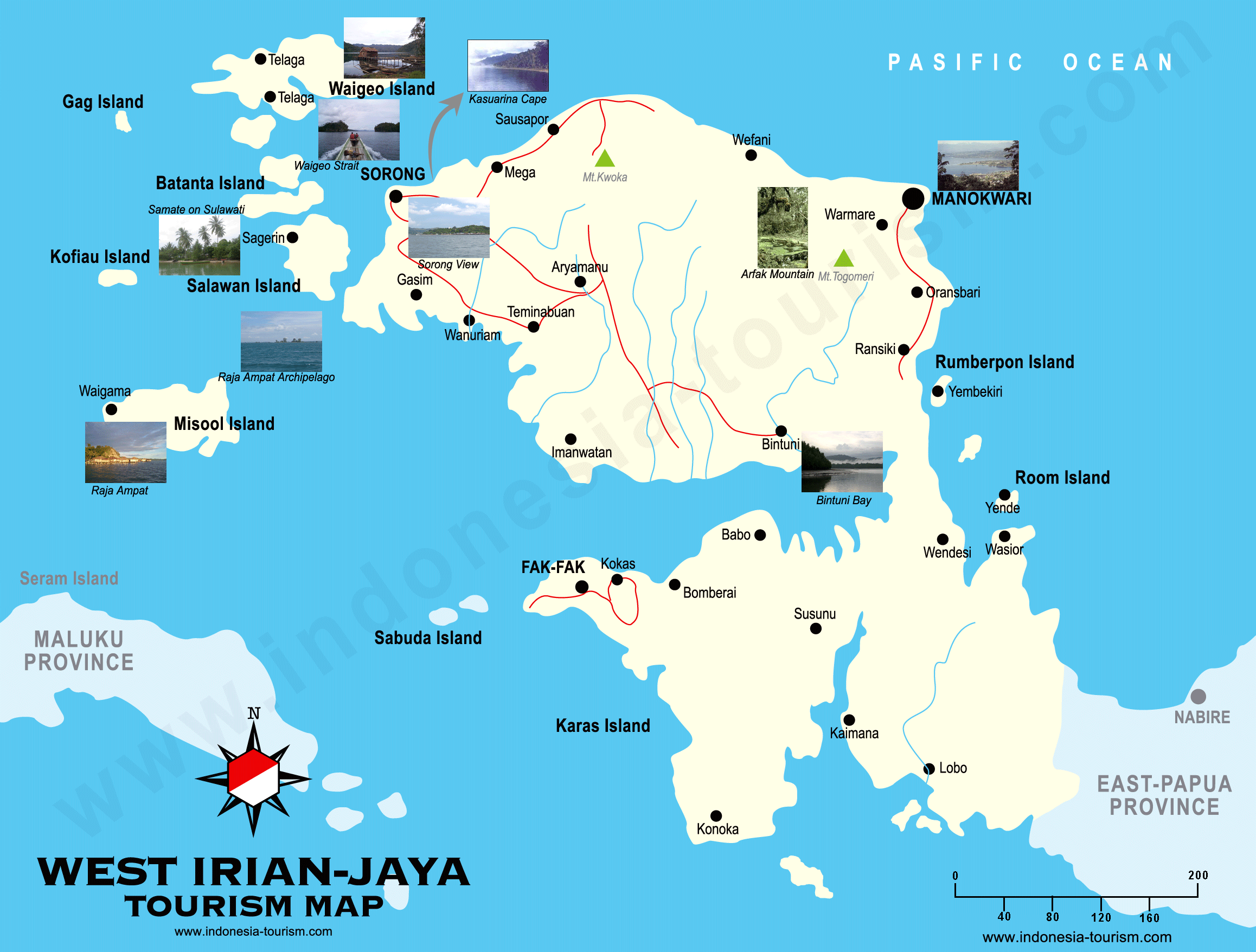
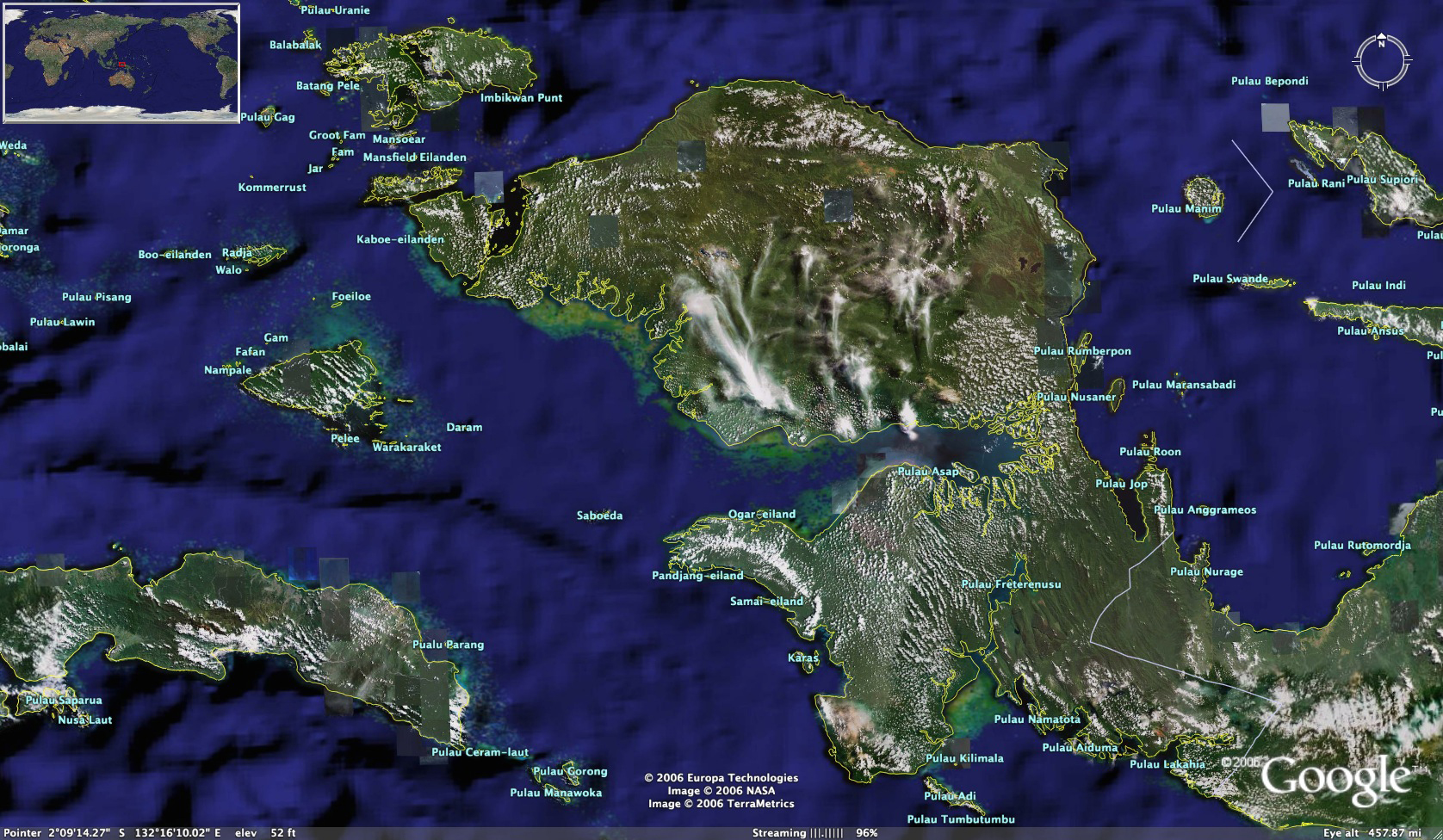
6. West Papua (now ‘Irian Jaya’): West Papua is the most isolated and sparsely populated provinces of Indonesia. See www.westpapuatrekking.com/introduction.html and www.papuaweb.org/dlib/tema/kamoro/muller/tourism-irja.rtf for details, a map at www.indonesia-tourism.com/west-papua/map/west_irian_jaya.png, a satellite map at http://www.indonesia-tourism.com/west-papua/map/west-papua-shigh.jpg and www.westpapuatrekking.com/photosanditineraries.htm for photos. I could not find any signs of canoeing in Irian Jaya apart from natives making a canoe – see www.travelvdo.com/video_irian-jaya-mario-3_356.

Tour Operators, Travel Guides & Consultants
There are a number of rafting tour operators in Indonesia, though I would exhibit care about whom you go with. You need to be concerned about the quality of their training and equipment. Mind you a lot of the concern is a lot of competitive humbug, as the risk depends on the grade of the river. You also need to check out who they are affiliated with since some ‘associations’ are no more than self-appointed chieftains.
1. Jenars Adventurindo, Jalan Raya Tomohon 452, Kakaskasen Dua, Tomohon Utara - 95365, Sulut, Indonesia. Tel/fax: (62-431) 3157154 Email: info@adventurindo.com
2. P.T Korindo Network Lintas Raya Tours and Travel - Jalan Intan 3 Blok D No:14,BTN Bumi Selaparang Asri Belencong,Gunung Sari,Lombok Barat,West Nusa Tenggara(NTB),Indonesia Tel: (62-370) 6649108 Fax: (62-370) 647327 Website: www.korindo-network.com
3. Indonesian Whitewater Federation (Federasi Arung Jeram Indonesia) - see www.faji.org
. Email: pb_faji@faji.org. See the rafting calendar - www.intraftfed.com/competition/calendar.html.
4. Azimuth Adventure Travel Ltd, Jalan Pandega Marta VI/4 - Catur Tunggal, Yogyakarta 55281, Indonesia. Tel: (62-274) 560 663 Fax: (62-274) 560 663. Email: info@azimuth-travel.com
Website: www.azimuth-travel.com/our_trips.php?prog_id=8&lang=eng.
5. Sobek: See www.bali-travel-online.com/bali/white_water_rafting/sobek.htm
.
6. Indosella Expedition: Perumahan Azalea Blok B/15, Panakkukang Mas, Makassar, South Sulawesi, Indonesia. Tel: (62-411) 5073499 Fax: (62-411) 439057, Email: Hernan.Halim@gmail.com
. Website: www.indosella-expedition.com/kayaking.html,
7. Personal guide - T.Y. Johan S. - tour guide for river rafting and mountain trekking - Wisma Cinta Alam - Jln. Blangkereren - Ketambe - 24652 Kec. Badar - Kab. Agara - Aceh Indonesia

Maps of Indonesia & its Provinces
See www.indonesia-tourism.com/map


Other Information Resources:
www.indonesiapromo.com/rafting.html

www.infohub.com/TRAVEL/SIT/sit_pages/8786.html

http://indahnesia.com/indonesia/SUTLAW/bukit_lawang.php

www.indecon.or.id/pdf/Nsumatra.pdf

www.travel-indonesia.com/index.cfm?menuid=30

http://indahnesia.com/indonesia/SEESKA/see_south_kalimantan.php

www.borneoexpress.com/borneo_national_parks.htm

------------------------------------
Andrew Sheldon www.sheldonthinks.com

Rafting the Chico River, Cagayan Province, The Philippines

The Chico River flows east to Tabuk City, before joining the Cagayan River 40km to the north. Tabuk City is easily reached by bus from Tuguegarao City, which provides a flight connection to Manila (PR208). Alternatively you can travel on the Haisema Mountain Highway from Baguio City or the Mountain Polis Highway from Manila. From Tabuk City you can get a jeepney west to Pasil in Kalinga municipality.
There is a 4 hour rafting adventure offered on the Chico River between Pasil and the exit point at Tabuk. The trip covers beautiful scenery such as gorges and waterfalls. The rapids on the Chico River are rated as Grade 2 to 4. After the trip, you can easy get a meal in Tabuk City, and commute back to Tuguegarao City for a flight to Manila (PR237).
Marsman Drysdale Travel Inc organizes rafting adventures on the Chico River from their head office at: 19th Floor Robinsons Summit Center 6783 Ayala Avenue, Makati City, Philippines or visit their website www.marsman-tours.com.ph
. Email: inquiry@marsmandrysdale.com. Telephone: (63-2) 887 0000.

Location Map References for Chico River: See http://maps.google.ca/maps?f=q&hl=en&geocode=&time=&date=&ttype=&q=chico+River+Philippines&sll=15.029686,119.20166&sspn=10.236578,20.43457&ie=UTF8&ll=17.39389,121.294556&spn=0.158242,0.31929&t=h&z=12&om=1
Info about Tabuk City – see http://en.wikipedia.org/wiki/Tabuk_City%2C_Kalinga
-----------------------------------------------
Andrew Sheldon www.sheldonthinks.com

Thursday, May 15, 2008

Canoeing the Mokihinui River, Sth Island, New Zealand

I've got a good idea where I will be going on my next trip to NZ. I've just been reading how the NZ government is about to dam the Mokihinui River on the West Coast of New Zealand. Looking at the YouTube video below, it appears to be a pretty scenic river, with a mix of Grade 1-3 rapids. Though I'm gauging that purely from the river so do your own research. The Mokihinui River is the longest river on the West Coast of NZ, but that’s not saying much since the catchments are small.
I go hate to see river catchments destroyed. This one is fairly scenic. In this case it’s not readily apparent why there is a need for hydro electric power since there is a significant amount of coal in the area. So greenies, you can choice your poison – a coal fired power station or a hydro scheme. Regardless one suspects someone will be making your mind up for you. But at least dissident canoeists can have their chance for a canoe because I dare say government will be debating the issue for another 2 years before construction will prevent canoeing. In the interim here is an idea of what will be lost.
Also, check out the link from the Forest and Bird website: http://www.forestandbird.org.nz/conservation/freshwater/mokihinui.asp where you will ways to help Save the Mokihinui River.

-------------------------------------------------
Andrew Sheldon www.sheldonthinks.com

Tuesday, April 15, 2008

Strategies for a weekend adventure

I think in any city where you are surrounded by nature you want to get away for a weekend at least to escape the city. But that is not enough to preserve your interest. You can relate and read a book by a pool, but then you have probably done plenty of that in your own home city. For something new I have several ideas:
1. You take a weekend and hire a campervan and go tripping. But dont just lounge around. Find that fishing gear that you never seem to use, or borrow a friends, and get yourself a canoe so you can enjoy a new experience.
2. Go horse riding for a weekend. Find one that just doesnt walk you around the paddock but takes you up on the range, perhaps with several days camping, or maybe a shorter trip up an isolated river valley.
3. Go mountain biking through some mountain forest trails

It really doesn't cost a lot these days to participate. You can even use the same helmet for canoeing as for horse riding or mountain biking. There is decent equipment made in China if you know what you need, so there is another saving. You can even buy 2nd hand if cash is scarce. These are all great activities for families as well. All my brothers have been canoeing with me. you can buy a decent canoe for as little as $US75 depending on where you live, mountain bikes $150-175. You dont need the latest & lightest, why not start slow with a 2nd hand product. You xan always find another 'sucker' to pay what you did, unless you are real slow to sell it.

My preference is not to make these adventures a one-off but to perform them on a sub-routine basis. Clearly biking is a great activity that you can perform daily, whereas canoeing and horse riding take too much time away from the other things I do. My intent is to challenge myself in work, relationships, recreation and investment. Always seek new opportunities for a challenge. Of course you can only do one thing at a time. This is not a lesson for some. For others its a revelation. For others still, they talk it, but never seem to find the path. I hope you can find the encouragement and resources on this website to take you there.
---------------------------------------------
Andrew Sheldon www.sheldonthinks.com

Saturday, March 01, 2008

Sunday, February 10, 2008

Why buy an inflatable canoe?

Inflatables have long been recognised for their application in watersports, particularly in marine and swimming pools. But as plastic moulding and sealing technologies have improved, its now possible to buy well designed inflatables that closely resemble the fixed hull canoes that most people are accustomed. Lets consider some of the pros and cons of inflatables for canoeing.

The pros of inflatable canoes
The benefits are:
1. Inflatables ride over river gravels better than fixed kayaks because the plastic material glides over smooth rocks much better. This is facilitated by the more even weight distribution, which also gives you better clearance. I find that I can get even better clarance or weight distribution by suspending my butt in the air so the weight is on the front and back. But I find the material readily slides over these rocks.
2. Inflatables are much more comfortable to ride because you can more easily flex your limbs and the hull gives, so your weight is more evenly distributed. Some designs are better than others because they are equipped with a separate air cushion. Another design uses straps to support the seat...I dont like that type.
3. Inflatables are more easily transported. I have taken my inflatable canoe on public transport in Japan (though I suggest taking a collapsible paddle). The benefit is that there is very little portage required if you live near a station and the train follows the river valley. The same portability makes them great for storing them in the rear compartment of a car. Being inside the car means they are moe secure. I dont want people to know what I am doing in the local area for safety reasons, and I want my possessions secure inside the vehicle.
4. Inflatables are lighter to carry. Whether you need to portage your canoe to a remote river, or negotiate a steep forest trail to avoid an impassable section of river (eg a waterfall), you will appreciate avoiding the safety and exhaustion issues that plague fixed hull canoes. If you slip with a fixed hull canoe you will very likely break your back or hit your head. An inflatable is light and soft so your hands are effectively free to break your fall. I often dont even bother deflating my inflatable to negotiate any river portages. I can carry it in one hand or carry it overhead for greater visibility and 'hands free' in slippery situations.
5. Inflatables are more compact. The relative compactness of inflatables makes them well suited for taking overseas as normal luggage. You can even store them in some train station compartments, though these services are disappearing because of the terrorist threat.
6. Inflatables are surprisingly robust. I've taken my inflatable on about 8 rivers with no signs of wear & tear. I had a puncture on the 6th occasion, but I just packed up the canoe, walked up to a bus stop and took it home for repair. The polyethylene material gives alot, wrapping around rocks and sticks. They tend to just absorb the impact so you dont get punctures. Firstly because of the air cushion, and secondly because the plastic stretches. The puncture I had was actually more of a slash than a puncture. That is evident from the cleanliness of the cut, so I suspect there was broken glass in the very shallow river. I actually deserved the damage given the shallowness of the river. A fixed hull canoe could not even have passed this section. Generally there is very little sign of wear and tear apart from this puncture, so I am convinced its a rare occurrence.
7. Water Discharge: All canoes eventually accumulate alot of water in them requiring you to flip them over. Rest assured its alot easier to discharge an inflatable canoe, though they do tend to gather more water too if they are open as opposed to 'enclosed' kayaks.
8. Boarding the canoe: I think boarding a canoe from land or water is alot easier than with an inflatable than a fixed hull canoe because the inflatable absorbs or gives, whereas the fixed canoe will rock causing instability. Similarly boarding from the water is easy from water because the canoe gives and does not rock as much. They require a different mode of entry from river banks. You would tend to enter from a low centre of gravity or from the water. You dont step into them since you would likely ruin the seams.
9. Stowing gear: I find the inflatable very good for stowing gear because you can wedge gear in the front and aft of the canoe, and you can secure it with the straps or just the inflatable seat that comes with the canoe.
10. Repair: You might argue that an inflatable is more likely to get a puncture than a fixed hull canoe, but I would argue that its easier to fix an inflatable on the river than a fixed hull (fibreglass or plastic) canoe. Regardless, either can be fixed by applying waterproof tape.
11. Sleeping compartment: According to the design specs for inflatables they are not designed for sitting in on land. But I wonder if they could in fact be used for sleeping as a substitute for a tent. The obvious advantage is that you could reduce your weight and bulk stowage needs - for a tent and sleeping bag. Modern tents though are pretty light though. There is some appeal to the idea of sleeping in a wet suit, whether on land or the river (depending on the design specs), but I have yet to test this concept.
12. Safety: I believe inflatables are far safer than fixed hull canoes, particularly where children are concerned. Its hard to imagine being trapped in one unless it was punctured by a tree and deflated around you. They are not going to give you a head injury.
13. Mobility:
Inflatables offer by far better mobility - whether you need to traverse steep slopes or rugged gorge country. This is true whether you have it packed in a backpack or you carry it in a bag. Why? In a backpack it leaves your hands free, and if you decide to carry it, its easy to dispense with until you regain your balance. You dont have to worry about a heavy object falling on you or undermining your gravity. Like any other canoe its harder to navigate through bush, so for long portages you might want to deflate. For accessing those wild wilderness rivers lacking road access or a helipad, there is no better solution.
14. International trips: Buying equipment for an overseas trip can present a hassle paying on credit card or establishing a receiving address, particularly in a foreign country where you cant trust vendors. Inflatables offer the option of taking your boat with you. Airlines are now enforcing strict limits on the weight and types of luggage they are prepared to carry. The light weight of inflatables makes them cheaper to transport overseas. They weigh about 20kg. An inflatable canoe can always be carried in a standard box, whereas for a fixed hull canoe you will need a commercial transport company. eg. British Airways recently decided to ban surfboards, kayaks & windsurfers from their flights. You can't even pay extra, forcing travellers to freight their boat/boards via surface mail. If other airlines follow suit, this would be a huge restriction on canoeing. For some this might be reason enough to buy an inflatable since it would be classed as normal luggage since it comes in a box. See related article.
15. Multipurpose: The Sevylor Tahiti Inflatable Canoe is not designed for this, but I suspect you could use this canoe as bed. Seylor advises users not to use inflatables on-land, but I suggest there might be compelling reasons to do so. The inflatable might make a comfortable bed if you are careful. Having said that, tents and foam insulation are likely more comfortable and light to carry. Just an idea. Your weight should be equally distributed by the air, so I can't see a problem as long as you avoid sudden impacts because water does give.
Sevylor Tahiti Inflatable Canoe - Buy Now!

The cons of inflatable canoes
The only things I don't like about inflatables are:
1. Navigability: Inflatables don't steer as well as fixed canoes because they are not rigid. You can buy an attachment to improve the steering which works well. For whitewater, the diminished steerability is only a problem for technically difficult rapids. Inflatables are not as appealing on open water because of wind drag. Inflatable canoes experience greater wind shear, so I would tend to avoid them if you intend to use your boat mostly on lakes or broad rivers. For whitewater, you are unlikely to experience much wind as rivers are generally protected by V-shaped valleys and overhanging trees.
2. Speed:
On open, flat water an inflatable canoe can feel a little sluggish. This sluggishness is somewhat offset by their lighter weight.
3. Weight: A fixed hull canoe offers greater weight carrying capacity. This is not a problem for short trips or if you are very careful with your stowage weights, but it might restrict touring trips. I however think there is the opportunity for using an inflatable as an air mattress, which means you dont have to carry a tent (assuming you are one person per canoe).
4. Vulnerability: One problem with inflatables is that they are more easily damaged, so if they are damaged in an isolated area, you might have a problem fixing them. Its not that they cant be fixed, its more likely that you might be delayed until after dark. My experience however is that you tend to get holes from man-made objects (not from rocks or branches) such as steel or glass shards, which tend to be around people anyway. So be more careful when passing concrete foundations, particularly at old bridges. I have never fixed a canoe on the river because all my canoeing experience with inflatibles has been on rivers with good access, so I've just taken the damaged canoe home for proper repair. On the positive, the only hole I got in the canoe was due to a glass or steel, and you are unlikely to have such materials in remote areas unless its civil works related.


Sevylor Tahiti Inflatable Canoe - Buy Now!

The best canoe to buy!

River running is without a doubt one of the best sports to engage in I believe. But there are several options to choose from:
1. Kayak: A kayak is an enclosed vessel first conceived by the Eskimos. It has a sealed flap to ensure little water enters the manhole. The benefit of a kayak is that they are faster, more maneuverable and self-driven. Different kayaks are designed to offer variable stability, buoyancy, speed and navigability.
a. Fixed type: These types are made of solid polyethylene or fiberglass, providing them with a high level of rigidity, but also some flexibility to absorb shocks on the river.
b. Collapsible type: There are collapsible kayaks which have a frame, so you can compact the kayak for storage or cartage. These are only suitable for sea kayaking.
2. Canoe: A canoe is an open vessel with the capacity to carry 2-3 people, otherwise used for greater storage capacity. Different kayaks are designed to offer variable stability, buoyancy, speed and navigability. There are 2 types of canoe:
a. Fixed type: These types are made of solid polyethylene or fiberglass, providing them with a high level of rigidity, but also some flexibility to absorb shocks on the river.
b. Inflatable type: These types are made from various grades of plastic. Inflated by pump, the air pocket provides a different type of cushion to absorb shocks. Inflatables have the advantage for cartage and storage.
3. Raft: Raft are open, broad, polyethylene inflatable vessels equipped with tie-lines to offer passengers greater security. These vessels are less navigable but can carry a great many people and if the river is wide enough, they are able to handle large rapids with ease.

When buying a vessel you really need to decide which type of material and design suits your needs. You need to decide whether:
1. You will be riding river rapids, beach surf lake waters, and the type of conditions
2. You will be taking short trips or doing overnight tours requiring more storage for food & overnight camping.
3. You need to decide the number of passengers – Will you be accompanied by friends, kids, and can they handle an independent vessel?
4. You need to decide the level of autonomy you want to have, or whether you see it more as a social activity.
5. You need to decide your motives for running a river? Is it to explore, to feel the excitement and adrenaline, or to look at scenic nature. Is it intended to be a social activity?

Ideally I prefer kayaking because of the greater control that a kayak offers, but I find the need to lug around a fixed kayak too much of burden, both for security reasons and storage. An inflatable can easily be packed in the back of a vehicle, taken on a plane, bus, train or even overseas. They are navigable and strong enough to run river rapids, and carry supplies for 1 person. My primary reason for running the river is the adventure, nature and tranquility, the social interaction is secondary, so I prefer to run solo. But actually I think solo experiences are more social because they are not shared. Anyway inflatables are far more flexible.


Sevylor Tahiti Inflatable Canoe - Buy Now!
------------------------------------
Andrew Sheldon www.sheldonthinks.com

Monday, January 14, 2008

Canoeing the Magat River, Nueva Viscaya, The Philippines

The Magat River flows north of Santa Fe town, in Nueva Viscaya, in Central Luzon. The section of river suitable for canoeing is marked on My Google Maps at http://maps.google.com.au/maps/ms?hl=en&ie=UTF8&msa=0&msid=106791913239054408744.000443a6386cb1a223c36&ll=16.272028,121.03157&spn=0.319682,0.63858&t=h&z=11&om=1.
This river is well suited for novice canoeing. The water is Grade 1 to 2. The river offers only a short trip as the river quickly broadens out on the valley floor, and as the river disperses, the water becomes flat. Despite this the area is very scenic. At Aritao, the river is flat. The roads in this area are very straight and not so busy, though I performed my river survey on Sunday. Trucks and a multitude of tricycles are the biggest obstacle.


Canoeing at San Jose City, Nueva Eclija, The Philippines

The San Jose River is easily accessed from Manila by bus – it takes about 6 hours. Access to the river is easily achieved along the highway heading north, whether by car, bus or jeepney. The following map will help you plan your trip – see www.mapplanet.com/?do=map&id=4900470&lat=15.8600&lon=120.3847. Better still use the Canoe Trip Map 1 I have constructed at http://maps.google.com.au/maps/ms?hl=en&ie=UTF8&msa=0&msid=106791913239054408744.000443a6386cb1a223c36&ll=15.918413,120.976639&spn=0.320252,0.63858&t=h&z=11&om=1
The river is grade 1-2 gravel races, so its well suited to beginners, though it might be advisable to undertake the trip when there is more water in the river (ie. After rain) so you don’t spend too much time on gravel. According to my trip notes, and my limited observation of this river, the section marked is navigable and offers some water flow and the possibility of rapids. Some rapids are evidence from the Mahalika Highway, though these are mostly gravel races suitable for beginners and children. Above a marked river confluence there is too little water, and below the Cowboy Grill (exit point on the highway), the river is flat, and thus boring for all concerned.

Sunday, January 13, 2008

Canoeing the Ibulao River, Banaue Area, Philippines

Every holiday I go on I am always looking for opportunities to go mountain biking or canoeing. Since canoeing is not very popular in the Philippines, I tend instead to look for rafting opportunities. Actually I heard of rafting in Ifugao Province whilst staying at the Banaue Hotel in Banaue, Ifugao Province. I had actually passed the river during the night getting to Banaue, so I was pleased to know I would see it returning to Manila. The Ibulao River rises in the mountainous regions of Ifugao Province.

There are several sections that offer whitewater:
1. Mungayang to Ibulao Bridge: This section of river is popular for rafting. The following map shows the location of Mungayang – on the Mountain Polis Highway – see www.mapplanet.com/?do=map&id=4880970&lat=16.2364&lon=121.1442, though I am not aware of the entry point. The exit point from the river is the Ibulao Bridge – viewed at: http://maps.google.com.au/maps?f=q&hl=en&geocode=&time=&date=&ttype=&q=lamut+philippines&sll=15.9761,120.5711&sspn=0.009964,0.019956&ie=UTF8&ll=16.784019,121.121049&spn=0.004961,0.009978&t=h&z=17&om=1.It&time=&date=&ttype=&q=lamut+philippines&sll=15.9761,120.5711&sspn=0.009964,0.019956&ie=UTF8&ll=16.784019,121.121049&spn=0.004961,0.009978&t=h&z=17&om=1.It might be best to ask locals how to get access to the river from the Mountain Polis Highway, or call the Adventure company below. I am guessing the rapids are grade 1-3 in difficulty.
2. Ibulao Bridge to Lamut (??): The possibility or utility of canoeing this section is unknown. I personally checked out the rapids in the gorge below Ibulao Bridge from a track running along the northern side of the gorge – follow the sign to the caves. Apart from providing a view of the river, I have seen a overloaded jeepney go along this road, so it must continue for some time. It might even provide an access point to the lower section of river. It would however be preferable to access the lower section of river from the highway around Lamut as the Caves road is mostly one-way with few turning places. There is a log in the gorge that would obstruct rafts from passing, and the conditions would make portage difficult. The obstruction should not hinder canoes however if they take the central route with care. Eventually this river joins a larger river before flowing into a reservoir (dam), so an exit around the confluence (flowing north) would be preferred, if not earlier. The rapids in the gorge are grade 1-3.

See my Ibulao Canoe Trip 3 - marked on my Google Maps at
http://maps.google.com.au/maps/ms?hl=en&ie=UTF8&msa=0&msid=106791913239054408744.000443a6386cb1a223c36&ll=16.680924,121.224518&spn=0.638012,1.277161&t=h&z=10&om=1hl=en&ie=UTF8&msa=0&msid=106791913239054408744.000443a6386cb1a223c36&ll=16.680924,121.224518&spn=0.638012,1.277161&t=h&z=10&om=1.


Accommodation is available in Banaue (The Banaue Hotel for P2300-3300/night) or Youth Hostel for P250/night) or perhaps Bagabag in the Cagayan Valley. See the following websites for video-photo footage of the river from people who have rafted this river with Uerm81 Adventures (email: totokalug@yahoo.com, Cell: 0919 694 5964) - see www.dailymotion.com/video/x1f4tf_river-wild and http://nl.truveo.com/Attandi-cudog/id/2769409785, and heaps of photos at www.flickr.com/photos/ral_m/page29. If you are concerned about leaving your vehicle around and like the idea of using inflatables, consider public transport options. Public transport necessitates travelling with an outdoors adventure company or using inflatable boats.
The options for transport include:
1. Bus from Manila – transfer in Cabanatuan City or Bagabag. Jeeyney to Banaue, and exit near river.
2. Bus from Manila – transfer in Baguio to Banaue jeepney.

Whitewater tubing the Sibulan River, Davao del Sur, Philippines

I have no paticular interest in 'tubing' but here is a blog by a guy who seems to get around more than me. See www.ivanhenares.com/2006/09/whitewater-tubing-in-davao-del-sur.html. This blog posting describes his whitewater tubing adventures on the Sibulan River in Barangay Santa Cruz, in the southern (Mindanao) province of Davao del Sur, close to the boundary of Davao City.

Wednesday, January 02, 2008

Comparison of Inflatable Canoes

At this point in time I have only used the Sevylor 'Tahiti' inflatable canoe. Though for the sake of completeness I want to consider the other alternatives:

1. Sea Eagle Explorer: Sea Eagle manufactures 3 variations of its inflatable Explorer canoe. See http://www.seaeagle.com/HullCompare.aspx?hullCatID=EX. There are 2 elements about the specs that I dont like. The $900-1000 price and the seat design.

2. Sevylor Tahiti: Sevylor produce a range of inflatables. There are 2 different designs - the 2-man Tahiti and the 1-man Bali. For a little extra weight I think its worth buying the Tahiti for the additional storage capacity. You can buy these canoes for under $300. I love the inflatable and adjustable seat design. The only things I dont like was the colour and the lack of a carry bag. I could not get the thing in my box, though I note that Japanese customs were able to do so when I freighted one to Japan. I like the one-way valves, just wished they were used on all compartments. If you want the vessel to paddle in a straight line - get the skeg accessory. But I like whitewater, so I prefer not to use it.
Sevylor Tahiti Inflatable Canoe - Buy Now!

3. Intek AirHead Inflatable Canoes: InTek manufactures a 1-man and 2-man designs of their Airhead inflatable canoe. I have not used this canoe, but the netting at the front could be a dangerous entanglement in whitewater canoeing. Anyway its only designed for moderate whitewater. Also I dont like the sea. The price is moderate at http://www.cabelas.com/.

4. Soar 12 Inflatable Canoe: Soar1 producers several inflatable canoes for around $1200. I dont like the design of the seats, and I think the heaviness would limit the portability of the vessel.Its also an expensive option. See www.soar1.com/soar_12.htm.

5. Gumotex Safari: This whitewater canoe an option. I like the seating style, though I have not tried this specific model. I think the netting for holding equipment presents a safety risk in whitewater because of the possibility of entanglements. Though its an open netting, so not too risky. The price is far more than the Sevylor Tahiti.

Overall I think the Sevylor Tahiti is the best design - and its sold at a very competitive price!
Sevylor Tahiti Inflatable Canoe - Buy Now!

Sunday, December 30, 2007

Canoeing on the Pinacanauan River, NE Luzon, The Philippines

The Pinacanauan River is located in Cagayan Province in NE Luzon, in the Philippines. The city of Tuguegarao lies at the confluence of the Pinacanauan River and the much more significant Cagayan River. The best way to reach the Pinacanauan River is by road (Mountain Polis Highway) from Manila or flight PR208 from Manila to Tuguegarao. Upon arriving at Tuguegarao, take a jeepney destined for Peñablanca, and continue further upstream. If you refer to the map reference for Callao Caves below, you will see that there is a belt of limestone crossing the river. This formation hosts a multitude of caves, some of which you may access from the river. Search Google for more info on Callao Caves.
For accommodation, you can camp on the river or try staying at the Lorita Hotel in Tuguegarao.
Marsman Drysdale Travel Inc organizes kayaking trips on the river through their offices at: 19th Floor Robinsons Summit Center 6783 Ayala Avenue, Makati City, Philippines or visit their website
www.marsman-tours.com.ph. Email: inquiry@marsmandrysdale.com. Telephone: (63-2) 887-0000 (Trunkline). In fact that run a 4 day/3 night Northern Luzon Wilderness adventure tour involving caving, rappelling, kayaking and whitewater rafting.
The Pinacanauan River offers grade 1 to 2 rapids suitable for kayakers.


Location Map References
1. Google Maps – Try searching for “Pinacanauan River Philippines” at
http://maps.google.ca/maps?hl=en&tab=wl
2. Callao Caves – See
http://maps.google.ca/maps?f=q&hl=en&geocode=&time=&date=&ttype=&q=Pinacanauan+River&sll=3.951941,117.158203&sspn=41.419891,81.738281&ie=UTF8&ll=17.70323,121.822414&spn=0.078986,0.159645&t=h&z=13&om=1
3. Info about Tuguegarao: See http://en.wikipedia.org/wiki/Tuguegarao_City

Canoeing on the Pagsanjan River, Laguna, Philippines

The Pagsanjan River is located in the province of Laguna, Luzon in the Philippines. The river’s headwaters is the famed Mount Banahaw, from where is cascades through 3 gorges before reaching Lake Laguna. The river in fact provides 35% of the discharge into Laguna de Bay, despite being just one of the 21 major lake tributaries. For this reason the river is monitored by the Laguna Lake Development Authority(LLDA) at 15 river monitoring stations. The river is also referred to as the Pagsanjan-Lumban River after the towns of Lumban, Pagsanjan and Cavinti through which it flows. The river also hosts the popular the 100-metre high "Magdapio Falls" in the town of Cavinti, but also known as “Pagsanjan Falls”.
There are boat rides from Pagsanjan which run 16 rapids over a 17 kilometre section of the river, while passing through gorges and dropping several hundred feet before reaching the waterfall after the 14th rapid. The ride takes you through attractive natural bushland including orchids, ferns, vines, spiders, dragonflies, lizards and monkeys. The river grade I believe is 1-2, though I will not run it until I have a canoe shipped from China.


Map references
1. Township of Cavinti: See http://maps.google.ca/maps?f=q&hl=en&geocode=&time=&date=&ttype=&q=Cavinti+laguna&sll=14.268709,121.468449&sspn=0.040177,0.079823&ie=UTF8&ll=14.246498,121.506128&spn=0.040181,0.079823&t=h&z=14&om=1
2. Township of Pagsanjan: See http://maps.google.ca/maps?f=q&hl=en&geocode=&time=&date=&ttype=&q=Pagsanjan+laguna&sll=14.280936,121.505098&sspn=0.040175,0.079823&ie=UTF8&ll=14.268542,121.450768&spn=0.040177,0.079823&t=h&z=14&om=1

Photos
1. Photos of the Pagsanjan river: See www.panoramio.com/photo/515914

Canoeing the Bued River, Baguio City, Philippines

There are very few rivers in the Philippines suited to canoeing. I suspect the reason is the high permeability of the relatively recent volcanic ash covering the country. The implication is that surface water can flow in the high mountain gorges, but once they reach the alluvial flats, the river water quickly percolates into the alluvial flats leading only the sediment pile they carried. The Bued River flowing south west of Baguio City in central Luzon is a good example of this.
The only settlement of note along the river is Twin Peaks, though there are a number of old settlements that date back to the original construction of Kennon Road – numbering from Camp 1 in the south west to Camp 8 near Baguio. Kennon Road requires constant maintenance and several bridges have been upgraded, but the road is single carriage way along the length of the river, thus the 49km road takes 45mins to ride.
Upper Bued River Description
The Bued River Catchment is one of the most scenic in the Philippines. The precipitous drops from the 1600m high mountain tops to the valley floor have created some stunning scenery. The river between Baguio and Rosario has excellent road access given that the road follows the river. Yet in the upper section the drop to the valley floor is very steep. For this reason there are few opportunities to gauge the nature of the river - other than to say access is difficult in the upper section. There is however access, and the limited observation from the road suggests the river is for the most part too rocky to navigate at normal water.

At normal water levels the upper section (above the Twin Peaks Bridge) is not navigable because of the prevalence of boulders. There is however the possibility of navigating the river from several points upstream from Twin Peaks:
1. Highest: There is a bridge – so likely better access. See http://maps.google.com/?t=k&om=1&ie=UTF8&ll=16.2947,120.595508&spn=0.002487,0.004989&z=18
2. Intermediate: There appears to be a flying fox at http://maps.google.com/?t=k&om=1&ie=UTF8&ll=16.292054,120.592037&spn=0.002487,0.004989&z=18.
3. Lowest: There is a flying fox above Twin Peaks at http://maps.google.com/?t=k&om=1&ie=UTF8&ll=16.277677,120.568616&spn=0.002487,0.004989&z=18.
Observation during high water would be needed to establish the safety and suitability of the river under those conditions. The river gradient is steeper, so the possibility of treacherous rapids or falls is higher, and it is unknown whether any danger would be readily apparent. Notwithstanding the risk, there is an opportunity to start canoeing from the latter points. No grading of this section of river can be realistically be made.
Photo from the upper section - around Camp 4

Lower Bued River - Twin Peaks Bridge to Sison
Not having canoed this river – it does require a degree of caution. Though having observed the rivers character from the road it appears to have no treacherous rapids or falls below the Twin Peaks Bridge, however caution and experience is still advised. The river is narrow because of the V-shaped valley, and its strewn by rocks. At normal water the river grades 1-2, with the rock gardens tending to slow the river speed despite the moderate gradient in this section. Access is provided readily from the road, and local squatters tend not to mind the intrusion.

Photo of Boed River downstream from the Twin Peaks Bridge.
The Twin Peaks Bridge is located at http://maps.google.com/?t=k&om=1&ie=UTF8&ll=16.260199,120.556519&spn=0.002487,0.004989&z=18). From the Twin Peaks Bridge, at normal river height, the river appears to be navigable at least until the bridge at map reference http://maps.google.com/?t=k&om=1&ie=UTF8&ll=16.239393,120.521522&spn=0.002488,0.004989&z=18). There is another bridge further downstream at map reference http://maps.google.com/?t=k&om=1&ie=UTF8&ll=16.208179,120.509055&spn=0.002488,0.004989&z=18, however the river may have insufficient flow at this point. The lack of flow can be attributed to the rapid percolation of the river discharge into the permeable unconsolidated river ash that has coated the mountains in the catchment after the 1994 Mt Pinatubo eruption, and subsequently been dumped at the mouth of the valley as it enters the plain.

Baguio City Resources
The following resources might be helpful to you. The Bued River has a lot of history. The Kennon Road between Rosario and Baguio was built between 1903-05 by Japanese labour under the supervision of American engineers.
Ask questions at
http://www.baguiocity.com/bcmain_forum.php
Neighbouring Benguet Province – see www.benguet.gov.ph
History of Kennon Road
http://en.wikipedia.org/wiki/Kennon_Road
City office info
http://www.baguiocity.com/bcmain_ctprof.php Travel details - http://www.benguet.gov.ph/index.php?option=com_content&task=view&id=78&Itemid=159

Sunday, December 09, 2007

Vessel choice: Raft vs Canoe vs Kayak

River running is without a doubt one of the best sports to engage in I believe. But there are several options to choose from:
1. Kayak: A kayak is an enclosed vessel first conceived by the Eskimos. It has a sealed flap to ensure little water enters the manhole. The benefit of a kayak is that they are faster, more maneuverable and self-driven. Different kayaks are designed to offer variable stability, buoyancy, speed and navigability.
a. Fixed type: These types are made of solid polyethylene or fiberglass, providing them with a high level of rigidity, but also some flexibility to absorb shocks on the river.
b. Collapsible type: There are collapsible kayaks which have a frame, so you can compact the kayak for storage or cartage. These are only suitable for sea kayaking.
2. Canoe: A canoe is an open vessel with the capacity to carry 2-3 people, otherwise used for greater storage capacity. Different kayaks are designed to offer variable stability, buoyancy, speed and navigability. There are 2 types of canoe:
a. Fixed type: These types are made of solid polyethylene or fiberglass, providing them with a high level of rigidity, but also some flexibility to absorb shocks on the river.
b. Inflatable type: These types are made from various grades of plastic. Inflated by pump, the air pocket provides a different type of cushion to absorb shocks. Inflatables have the advantage for cartage and storage.
3. Raft: Raft are open, broad, polyethylene inflatable vessels equipped with tie-lines to offer passengers greater security. These vessels are less navigable but can carry a great many people and if the river is wide enough, they are able to handle large rapids with ease.

When buying a vessel you really need to decide which type of material and design suits your needs. You need to decide whether:
1. You will be riding river rapids, beach surf lake waters, and the type of conditions
2. You will be taking short trips or doing overnight tours requiring more storage for food & overnight camping.
3. You need to decide the number of passengers – Will you be accompanied by friends, kids, and can they handle an independent vessel?
4. You need to decide the level of autonomy you want to have, or whether you see it more as a social activity.
5. You need to decide your motives for running a river? Is it to explore, to feel the excitement and adrenaline, or to look at scenic nature. Is it intended to be a social activity?

Ideally I prefer kayaking because of the greater control that a kayak offers, but I find the need to lug around a fixed kayak too much of burden, both for security reasons and storage. An inflatable can easily be packed in the back of a vehicle, taken on a plane, bus, train or even overseas. They are navigable and strong enough to run river rapids, and carry supplies for 1 person. My primary reason for running the river is the adventure, nature and tranquility, the social interaction is secondary, so I prefer to run solo. But actually I think solo experiences are more social because they are not shared. Anyway inflatables are far more flexible.


Sevylor Tahiti Inflatable Canoe - Buy Now!

Rafting/canoeing in Malaysia

I have yet to canoe in Malaysia, though it can't too far off my schedule. I've identified a number of rivers that seem worthy candidates. As you may know Malaysia is split - with its sovereign territory occupying the Malay Peninsula (extending south of Thailand, but excluding the island of Singapore on the southern tip) and the northern portion of Borneo (where the Malaysian states of Sabah and Sarawak abut the southern Indonesia territory of Kalimantan). Anyway, Sarawak and Sabah are very rugged, remote wildernesses, and I'd say there are some adventures there.

The ranges of the Malay Peninsula and the mountains of Borneo offer some of the best remote whitewater rafting and canoeing in South East Asia. There are rivers suited for the whole range of river adventurists – from novice to expert. River rapids are categorized from Grade I-V (Class I is easy; III is “intermediate” and V is for the experts, with turbulent rapids, waves, holes and tough routes), so know your limits, or otherwise find an experienced and professional rafting company.

The most popular rivers (river means ‘Sungai’ in Malay) to canoe in Malaysia are:
1. Padas River, 170km from Kota Kinabalu, Sabah, East Malaysia: See
www.impression.com.my/sabah/kk/padas/padas.htm and www.sabahtravelguide.com/mapguide/default.asp?page=padas.
2. Selangor River, near Kuala Lumpur West Malaysia: There is a challenging 2hour run on this river, especially during the rainy season, with rapids ranging from Class I to Class V. See river info
http://impressions.com.my/Raft/raft_sel.htm.
3. Kiulu River in Sabah, East Malaysia: See http://www.impression.com.my/sabah/kk/kiulu/kiulu.htm
4. Kampar River, Perak State, Malay Peninsula: See
http://impressions.com.my/Raft/itek/itek.htm.
5. Sungai Itek River, Perak State, Malay Peninsula: See
http://impressions.com.my/Raft/itek/itek.htm.
6. Sungkai River, Perak State, Malay Peninsula: This river is better suited to kayaking.
7. Jeram Besu, Pahang State, Malay Peninsula: See
http://impressions.com.my/Raft/raft_JB.htm.
8. Telom River, Pahang State, Malay Peninsula: See
http://impressions.com.my/Raft/telom/telom_rafting.htm.
9. Kuala Perahu River, Pahang State, Malay Peninsula: See
http://impressions.com.my/Raft/telom/k_perahu/k_perahu.htm
10. Loh River, Trengganu State, Malay Peninsula: See
http://impressions.com.my/Raft/loh/loh_main.htm.
11. Sedim River, Kedah State, Malay Peninsula: See
http://impressions.com.my/Raft/raft_sedim.htm.

There have been numerous deaths on Malaysian rivers as a result of poor tour guide practices. Then there was the drowning of a Dutch tourist on the Padas River in November and another fatality this Dec-07. The risks posed are:
1. Rafting companies taking too high risks because of the desire to maximize profits. The implication is that they might:
2. Run river tours after heavy rains and no assessment of any damages that have since developed
3. Fail to practice safe procedures to safe time
4. Rafting company staff not having the experience to assess the risk due to inadequate training or lack of safety procedure adherence
5. If you want professionals I would go with river companies with experienced raft guides and the kayak rescuers on standby. The risk posed are adventurers getting trapped in holes, snagged by branches, trapped under the raft, though the buoyancy and headgear should otherwise prevent drowning and head injuries, assuming the gear is worn correctly. Choosing a responsible and safety-conscious operator is the key to avoiding mishaps. When rafting it does not help that 90% of any 13-party group are likely to be “virgins” to whitewater rafting.

Questions you can ask an operator before signing up for a rafting trip:
1. What grade is the river? Is it suitable for beginners?
2. What is your company’s safety track record like and what are the safety-and-emergency procedures?
3. Are your guides trained in Swiftwater Rescue and equipped with CPR and First Aid skills?
4. What kind of gear do you use and provide for participants (e.g. raft, helmet, PFD)?
5. Do you include insurance cover? Can this be arranged for us? Some companies like Pan-Global provide extensive coverage on outdoor sports
6. What is included in the cost?
7. What kind of clothing and things should one bring?
8. Do you have any referrals or testimonials from past participants?

Ensure the following:
1. You should be informed about the risks of rivers
2. The nature of rivers an how to pick features or characteristics
3. How to wear and use the safety equipment
4. How to paddle correctly – so you get good strokes and don’t hit your fellow paddlers with the oar.
5. What river guide instructions to listen to
6. Your guide should take you through some practice sessions on the river
7. How to stay in the raft when riding tough rapids
8. What you should do if you fall out or are thrown out of the raft, eg. Atch out for a throw bag (ie. a nylon sack).
9. They should be using good equipment
If you think you are going to be an experienced rafter after a trip – Think about. You are a fee-paying slave under instruction, getting the benefit of an adrenaline rush. Kayaking and canoeing offer you greater opportunity to develop independent judgement.

There are many rafting operators in Malaysia running the various rivers, though some have a dubious track record on the rivers and unsafe operating procedures. The operators with the best reputation are:
1. Tracks Adventures, a Selangor-based rafting outfitter in Kuala Kubu Baru. Tracks Adventures’ guides are all trained in Swiftwater Rescue, a course that teaches proactive prevention of river accidents and injuries certified by the New Zealand Canoeing Association. Guides learn to recognise and avoid common river hazards like “holes” that can trap and hold a buoyant object, and strainers (usually partly submerged trunks or logs) that can trap a swimmer underneath with the force of the current will hold him there. They practise self-rescue and methods of rescuing swimmers and recovering rafts and gear based on the American Canoe Association’s (ACA) syllabus (
www.americancanoe.org). Tracks Adventures has been running Selangor River since 1994. Tel: (60-3) 6065 1767; email: tracks@tm.net.my and www.tracksadventures.com.my.
2. Khersonese Expeditions: They are another experienced operator. Tel: (03) 7722 3511; Email:
info@thepaddlerz.com and www.thepaddlerz.com.
3. Riverbug: They are a Kota Kinabalu-based operator who has been in the business for 10 years. The company operates on Padas and Kiulu Rivers in Sabah, and Sg Kampar in Perak, and has offices in Perak and Kuala Lumpur. Their trainees have to run Grade I and II rivers at least 60 times, and grade III and IV 80 times before they are allowed to guide clients. Riverbug also uses safety kayakers on their runs. Tel: (60-3) 2162 0114 or
www.traversetours.com.

Many beginners are unaware of the dangers presented by rivers. Whitewater has swift and strong undercurrents. Listen to your guides safety tips carefully, follow their instructions, and exercise care. If you are risk-averse, don’t be lulled into going rafting. Avoid groups that take more than 3 rafts (30 to 40 clients) at a time, and those without rescuers in kayaks. Most accidents occur because clients don’t listen to instructions or they don’t take safety precautions seriously.